Bellevue 425-454-1283 · Lynnwood 425-672-2646 · Issaquah 425-392-0450 · Tacoma 253-328-4014
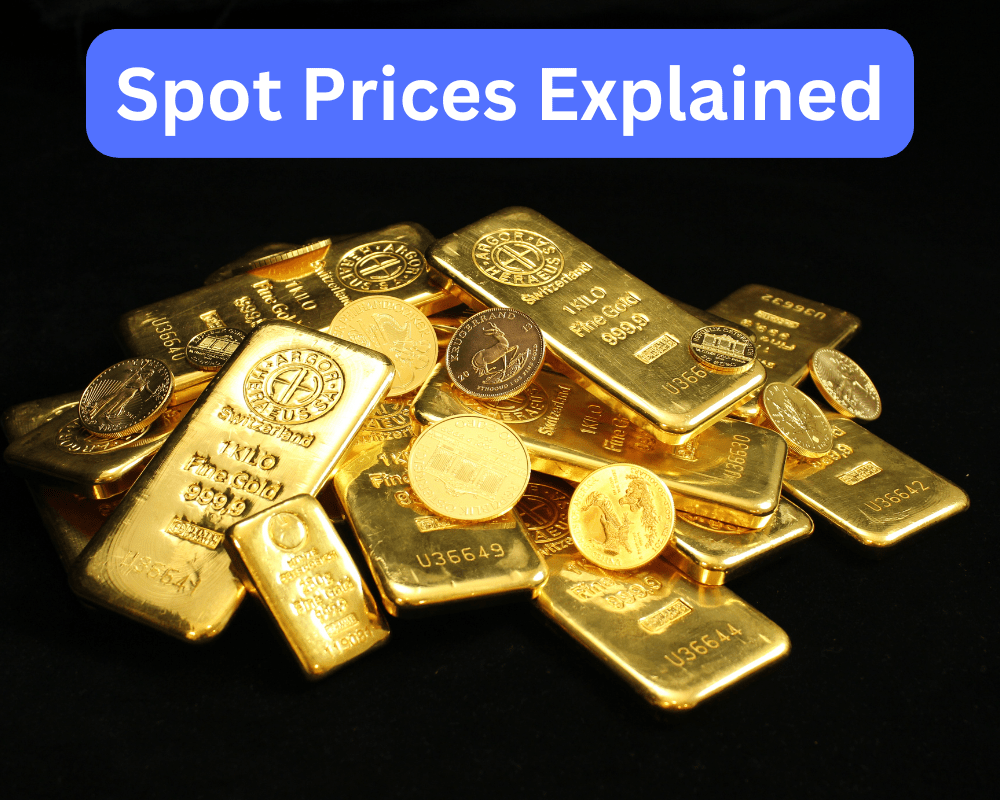
The price of gold is simply… the price of gold, right?
Well, that depends who you ask – and how deep into the topic you’d like to dig. For those curious, this explainer guide will go over how gold spot prices work: Who sets the prices, where the data comes from, and how spot prices can differ from the price you pay at your local coin shop or online gold dealer.
The “spot” price of gold (or any other precious metal) reflects the current market price at which bulk precious metals can be traded for immediate delivery. This is the price that major players in the gold space – like central banks, institutional traders, and major brokers – use when buying and selling gold on a massive scale.
Gold spot prices fluctuate constantly, similarly to stock prices. Nobody “sets” the spot price, really – it’s instead a result of supply and demand. Each large scale transaction affects the spot market, and demand drives price changes. If there are more buyers than sellers, the price rises – and vice versa.
Here’s a few more things to keep in mind about gold spot prices:
Gold spot price is not what you or I would pay when buying gold – but spot price influences the price we pay.
For the average person, the price of gold is usually something like: Spot price + Premium. Premium is the amount above the spot price for a piece of physical gold. For instance, something like a 1 oz Gold American Eagle might fetch a premium of around $100. So, if you were to purchase a 1oz Gold Eagle, you’d likely pay somewhere around (current spot price) + $100 – or about $4,450 at the time of this writing.
Spot markets are influenced by supply and demand. More buyers than sellers = prices increase, while more sellers than buyers = prices decrease.
Of course, it’s more complicated than that. Behind the supply/demand balance lies a variety of factors including:
Because there are so many factors at play, it’s not always easy to tell what is driving prices in one direction or another. Often, it’s a combination of factors.
To add to the potential confusion, there’s no one set “gold spot price”. If you look up gold spot prices online, you will see two sets of prices: “Bid”, and “Ask”
Bid = Represents the current highest price buyers are willing to pay
Ask = Represents the current lowest price sellers are willing to accept
There will always be a difference between these two numbers, and that’s known as the “spread”.
For example, at the time of this writing, here’s what the bid and ask prices look like:
Bid: $4,330.56 | Ask: $4,334.56
In this case, the “spread” (the difference between the two) is $4. This is fairly typical. During times of high market volatility, the spread might be substantially larger.
Spot price data comes directly from global commodity trading centers like New York and London. Importantly, the data comes from aggregate bid/ask data – meaning it’s a calculation based on the prices that buyers and sellers are willing to pay/sell for. This means that there is no real “official” spot gold price, but rather a best estimate based on the day’s buying and selling activity.
This is quite different from the stock market, where an official closing price is set each day.
Gold spot markets are fragmented, with various exchanges trading actively across the globe. This means that if you look up the spot prices in New York, it might differ slightly from the prices in Hong Kong.
Similarly, different data sources online will show slightly different data – because they’re pulling from different sources.
Ultimately, the discrepancies are very small for the average person buying or selling gold. In other words, any reputable source you look at for gold spot prices will be a very good representation of the average bid/ask prices on global markets currently.
To see current spot market data, check out our live gold prices page and our gold price today page.
And if you’re looking to buy or sell gold or other valuables, we hope that you will trust Bellevue Rare Coins. We’ve been proudly serving the greater Seattle community since 1979, and our convenient locations in Bellevue, Issaquah, Tacoma and Lynnwood make it simple to conduct your transactions quickly and easily. Schedule an appointment today, or stop into any of our stores (walk-ins are always welcome).