Bellevue 425-454-1283 · Lynnwood 425-672-2646 · Issaquah 425-392-0450 · Tacoma 253-328-4014
On February 28th, 2026, war broke out in Iran as a joint U.S./Israeli operation began in the region. The war has had devastating humanitarian and economic impacts, but today we’re looking at one very specific outcome: The relationship between gold and war.
How will the war in Iran affect gold prices, demand, central bank buying, and local supply?
Gold plays a large role in the world economy and in global monetary policy. When war breaks out, shockwaves ripple through political, economic, and social systems – resulting in a wide array of effects that are often unpredictable. What happens to gold prices during war?
Generally speaking, gold is considered a “safe haven asset”, which means that investors tend to buy it in times of uncertainty. Normally, this leads prices to rise. Has that played out this time around?
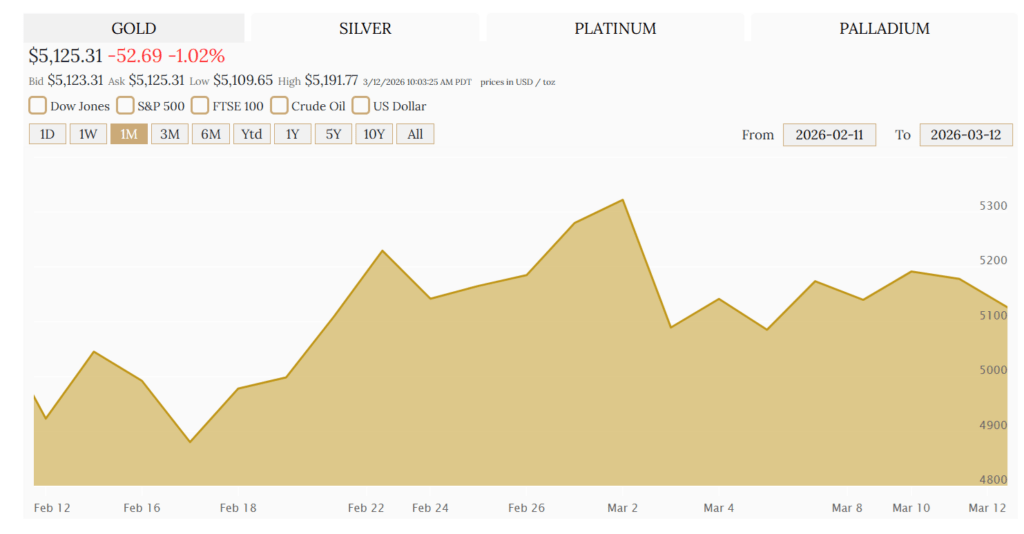
Not quite. When the war first broke out, gold spiked temporarily to over $5,300 per ounce, before dropping to around $5,080. It has since recovered somewhat, sitting around $5,120 at the time of this writing (see live gold spot prices here).
Overall, the response in gold markets has been muted, without major moves in either direction. As always, gold prices are being influenced by a wide variety of factors, including:
In this situation, we have a variety of major impacts affecting gold both positively and negatively – and the net result so far has been effectively no major change in gold prices.
Gold is often considered a safe, relatively stable asset class, which some view as less risky compared to stocks (equities). But in 2026, we’re often seeing gold prices move in tandem with “risk” assets like equities. Why is this?
Part of the reason may be gold’s incredible performance in the last year. Over the last 12 months, gold has steadily risen from around $2,900 an ounce to over $5,000 an ounce. We’ve also seen major swings in prices, and even larger ones in silver spot markets.
Because of gold’s rapid ascent, some traders may be betting that it has further to fall should the trend reverse. Others may simply be taking profits – selling at recent highs, or simply not buying as much.
This may be influencing the relationship between gold and war in 2026.
The short answer is that nobody knows for certain. The main economic effect so far has been surging oil prices due to the effective closure of the Strait of Hormuz. If oil prices stay elevated, the odds of an economic recession increase substantially.
The U.S. economy is less exposed than many global markets, due to high domestic oil output and ample strategic reserves. But with the interlinked global economy, disruptions to foreign markets is sure to ripple into the U.S. economy as well.
High oil prices could also lead to an uptick in inflation, which could lead governments to raise interest rates to combat rising prices. This could put short-term pressure on the price of gold, among a variety of other economic effects.
Other variables remain impossible to predict. So far, the war in Iran has strengthened the US Dollar, but it remains to be seen if that trend will continue. The war’s length and whether it escalates to a regional conflict also remain in question. Ultimately, the relationship between gold and war is just one of the many potential effects that investors and policymakers need to consider moving forward in 2026.